Need Help Designing Your Commercial Kitchen Layout? Email us: bids@jeansrs.com



Commercial Convection Ovens
-
 ✓ In Stock$36,940.00Unit price /Unavailable
 -
 ✓ In Stock$27,038.44Unit price /Unavailable
 -
 ✓ In Stock$34,805.00Unit price /Unavailable
 -
 ✓ In Stock$34,805.00Unit price /Unavailable
 -
 ⚠ Available to Order$13,672.56Unit price /Unavailable
 -
 ✓ In Stock$24,569.00Unit price /Unavailable
 -
 ⚠ Available to Order$13,910.00Unit price /Unavailable
 -
 ✓ In Stock$6,590.00Unit price /Unavailable
 -
 ✓ In Stock$6,590.00Unit price /Unavailable
 -
 ✓ In Stock$9,314.40Unit price /Unavailable
 -
 ⚠ Available to Order$6,229.00Unit price /Unavailable
 -
 ✓ In Stock$6,229.00Unit price /Unavailable
 -
 ⚠ Available to Order$4,250.00Unit price /Unavailable
 -
 ⚠ Available to Order$4,250.00Unit price /Unavailable
 -
 ⚠ Available to Order$4,250.00Unit price /Unavailable
 -
 ⚠ Available to Order$4,250.00Unit price /Unavailable
 -
 ✓ In Stock$13,598.00Unit price /Unavailable
 -

Used Restaurant Equipment - Lang GCCO-AP Baker-Depth Natural Gas Convection Oven - 60,000 BTU
✓ In Stock$2,400.00Unit price /Unavailable -
 ✓ In Stock$24,849.00Unit price /Unavailable
 -
 ✓ In Stock$12,200.00Unit price /Unavailable


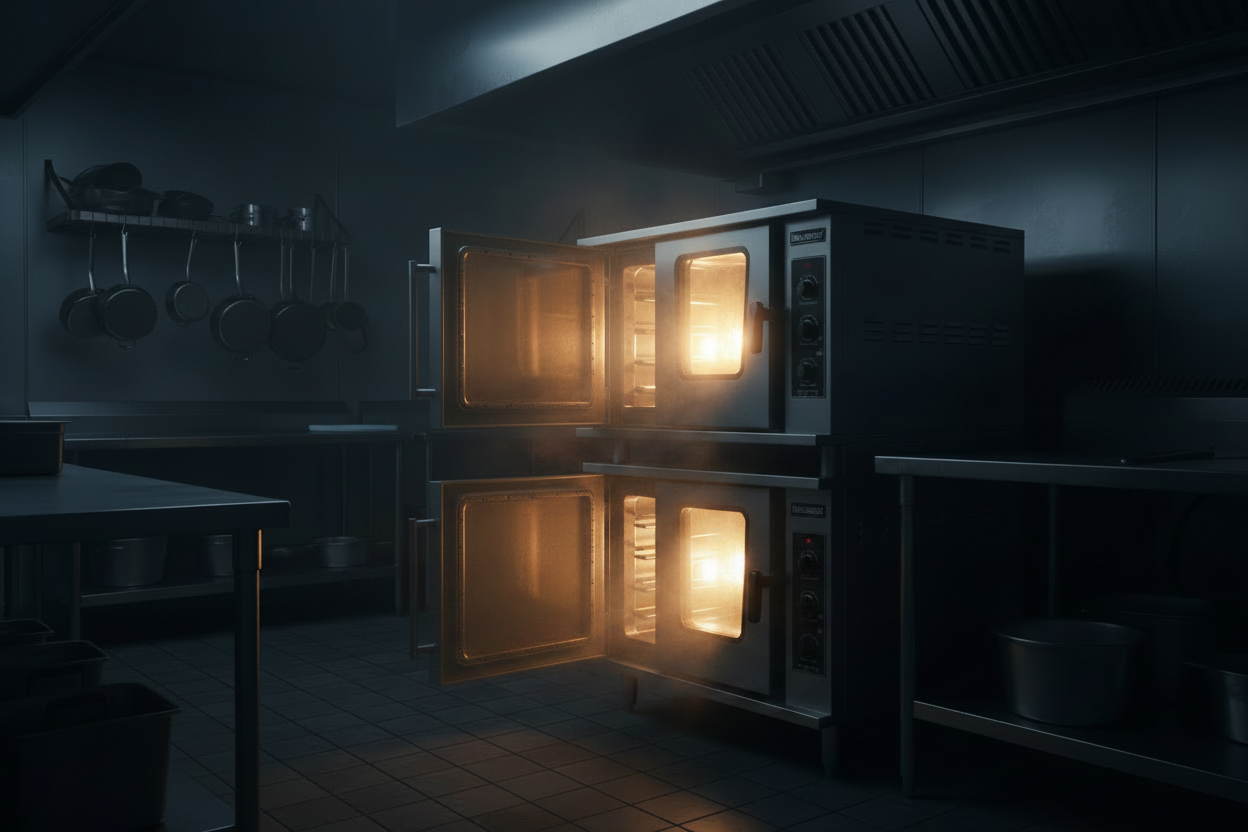
Commercial Convection Ovens: The Ultimate Buyer’s Guide for Professional Kitchens
High-volume commercial kitchens demand consistency, speed, and reliability. When it comes to baking, roasting, and batch-cooking, few pieces of equipment are as vital as a professional convection oven. By actively circulating heated air throughout the cooking chamber, these powerful units drastically reduce cooking times and eliminate the frustrating cold spots common in standard radiant ovens.
Whether you are upgrading an existing bakery setup, outfitting a new restaurant, or scaling up an institutional kitchen, selecting the right oven configuration dictates your utility costs, operational footprint, and final product quality.
Electric vs. Gas Convection Ovens: Which Power Source Wins?
The first and most critical decision you will make is choosing your oven's power type. Both configurations offer distinct operational advantages depending on your kitchen's existing utilities and cooking style.
Commercial Gas Convection Ovens
Typically engineered to run on either natural gas or liquid propane (LP), gas models are the undisputed workhorses of fast-paced foodservice lines.
-
The Advantages: Gas convection ovens feature rapid preheating and industry-leading temperature recovery times after the doors are opened. This makes them highly favored for heavy-duty roasting and high-turnover baking operations.
-
Best For: High-volume restaurants, catering operations, and kitchens with active gas lines looking to optimize speed.
Commercial Electric Convection Ovens
Electric convection ovens require dedicated wiring but offer unmatched precision and placement flexibility.
-
The Advantages: Electric units deliver incredibly stable, uniform ambient heat. Because they don't rely on a gas flame pattern, the temperature variance inside the cavity is virtually non-existent. Furthermore, they are simpler to install because they do not require a gas utility connection.
-
Best For: Bakeries, pastry shops, and precision kitchens where delicate items like soufflés, cakes, and artisanal pastries require exact, unwavering heat.
Size and Depth: Maximizing Your Kitchen Footprint
Commercial convection ovens are generally categorized by physical footprint and pan orientation. Choosing the right size ensures your workflow remains efficient during peak rush hours.
Full-Size vs. Half-Size Ovens
-
Full-Size Convection Ovens: Designed to accommodate standard 18x26 full-size sheet pans. These are the industry benchmark for medium-to-large restaurants and bakeries.
-
Half-Size Convection Ovens: Designed for 13x18 half-size sheet pans. These compact units are excellent for coffee shops, quick-service kiosks, or kitchens with limited countertop space.
Standard Depth vs. Deep (Bakery) Depth
-
Standard Depth: Pans are loaded into the oven from left to right (facing the unit). This is the traditional setup for most foodservice establishments and handles standard roasting and baking effortlessly.
-
Deep Depth (Bakery Depth): The internal cavity is altered so that full-size pans can be loaded from front to back, or side by side. This unique layout modifies the internal airflow patterns, allowing for superior heat distribution when baking dense batches of bread, rolls, or delicate pastries.
Single Deck vs. Double Deck Configurations
If you need to double your kitchen's cooking output but cannot afford to give up precious floor space, a double-deck convection oven is the ideal solution. Most major manufacturers build single-deck units that can be safely stacked on top of one another using specialized stacking kits. Stacking allows your kitchen to operate two independent cooking cavities—running at entirely different temperatures and timers—underneath a single ventilation hood footprint.
Frequently Asked Questions
Does a commercial convection oven require a ventilation hood?
Yes. In almost all local jurisdictions, commercial gas convection ovens must be installed underneath an approved Type I or Type II ventilation hood to safely evacuate heat and combustion byproducts. While some electric models may qualify for ventless operation depending on what you are cooking (e.g., baking bread vs. roasting grease-producing meats), you should always consult your local authority having jurisdiction (AHJ) and building codes prior to installation.
What is the difference between a convection oven and a standard deck oven?
Convection ovens utilize motorized internal fans to actively force hot air to circulate around your food, cooking up to 25% faster and often at lower temperatures than standard radiant-heat ovens. Convection is ideal for general baking, roasting, and sheet-pan meals. Deck ovens, conversely, utilize heavy stone or metal decks to transfer direct, intense heat to the bottom of an item, making them the preferred choice for artisanal breads and pizzas.
What utility requirements should I check before purchasing an electric oven?
Before ordering an electric convection oven, verify your kitchen's voltage (typically 208V, 240V, or 480V) and electrical phase (1-Phase vs. 3-Phase). Commercial ovens pull a significant amount of amperage and are designed to be hardwired directly into a breaker box by a licensed electrician rather than using a standard wall plug.
What utility requirements should I check before purchasing a gas convection oven?
Before ordering a commercial gas convection oven, verify whether your kitchen runs on Natural Gas (NG) or Liquid Propane (LP), as the burner orifices are entirely different. You will need to check the total BTU requirement of the unit to ensure your facility's gas lines can supply adequate pressure during peak usage. Additionally, don't forget that gas ovens still require electrical power—typically a standard 120V connection—to run the internal motorized convection fans, digital control boards, and electronic ignition systems.
Outfitting Your Kitchen with Jean's Restaurant Supply
At Jean's Restaurant Supply, we bridge the gap between high-performance equipment and local kitchen logistics. We carry a comprehensive selection of commercial gas and electric convection ovens tailored to your exact menu and budget constraints.
Have A Question About Commercial Convection Ovens?